

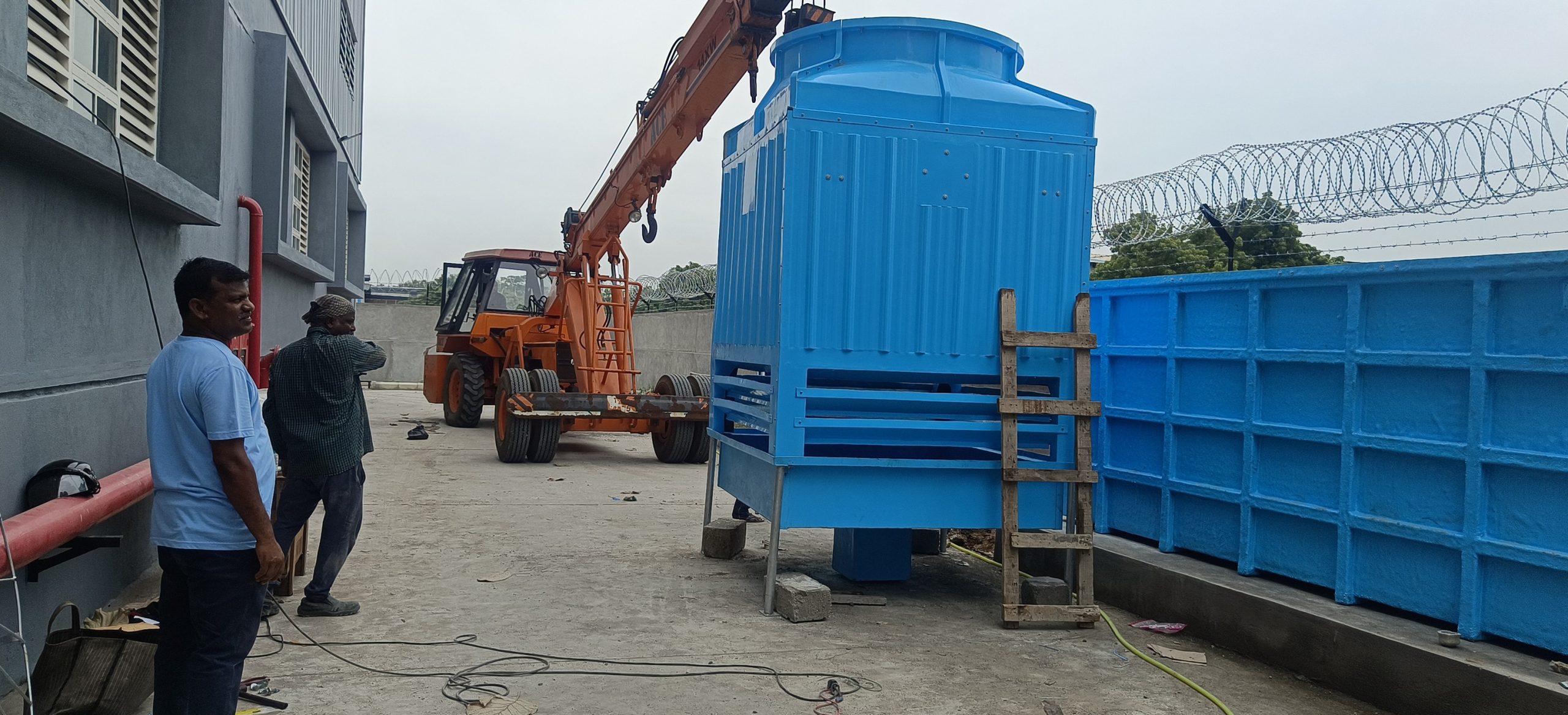
EVAPORATIVE COOLING TOWERS
Core Definition & Principle
An Evaporative Cooling Tower is a heat rejection device that uses the principle of evaporative cooling to lower the temperature of a water stream by rejecting waste heat to the atmosphere. It is the most common type of cooling tower for industrial and large-scale HVAC applications.
Fundamental Principle: When water is exposed to moving air, a small portion evaporates. This phase change from liquid to vapor requires latent heat of vaporization, which is drawn from the remaining water mass, thereby lowering its temperature.
How It Works: The Thermodynamic Process
- Hot Water Inlet: Warm water from an industrial process or HVAC condenser (typically 35-45°C) is pumped to the top of the tower.
- Distribution & Exposure: Water is distributed and broken into droplets or thin films over a “fill” or “packing” medium to maximize its surface area exposed to air.
- Air Contact: Air is moved through the tower (naturally or mechanically).
- Evaporation & Heat Transfer: A small percentage (1-2%) of the circulating water evaporates into the passing air stream. The latent heat required for this evaporation is extracted from the remaining water.
- Cooled Water Collection: The now-cooled water (typically 25-35°C) falls into a cold water basin and is recirculated back to the process.
- Warm, Moist Air Exhaust: The air, now warmer and saturated with water vapor, is exhausted to the atmosphere, often visible as a plume under the right conditions.
Key Components
- Fill/Packing: Increases contact surface and time between air and water.
- Splash Fill: Breaks water into droplets (good for dirty water).
- Film Fill: Spreads water into thin sheets (higher efficiency, prone to fouling).
- Distribution System: Nozzles or gravity basins to distribute water evenly over the fill.
- Drift Eliminators: Remove entrained water droplets from the exhaust air to conserve water.
- Cold Water Basin: Collects cooled water for recirculation.
- Air Moving Device:
- Fans (Mechanical Draft)
- Hyperbolic Stack (Natural Draft)
- Casing/Structure: Houses all components (FRP, concrete, wood, steel).
- Louvers: Direct airflow and contain water splash.
Types of Evaporative Cooling Towers
| Classification Basis | Types |
| By Air Flow Generation | 1. Natural Draft (Hyperbolic, large scale) 2. Mechanical Draft (Fan-driven) |
| Mechanical Draft Sub-Types | a. Induced Draft (Fan at top – most common) b. Forced Draft (Fan at bottom) |
| By Air/Water Flow Direction | 1. Cross Flow (Air horizontal, Water vertical) 2. Counter flow (Air vertical up, Water vertical down) |
| By Construction Material | FRP, Concrete, Wood, Galvanized Steel |
| By Shape/Form | Package Type (Factory-built), Field-Erected |
Key Performance Parameters
- Range: T_hot(inlet) – T_cold(outlet) – The temperature drop of the water. Indicates heat load rejected.
- Approach: T_cold(outlet) – T_wet_bulb(ambient) – How close the cooled water gets to the ambient wet-bulb temperature. Lower approach = Higher tower efficiency.
- Wet-Bulb Temperature: The theoretical limit for cooling. Water cannot be cooled below the ambient wet-bulb temperature.
- Cycle of Concentration (COC): Ratio of dissolved solids in blowdown water to make-up water. Higher COC = less water wasted but greater scaling risk.
- Evaporation Loss: ~1% of circulation flow for every 7°C (12.5°F) of range.
- Drift Loss: Tiny droplets lost with exhaust air (0.001%-0.2%).
- Blowdown: Intentional purge of concentrated water to control scaling.
Advantages
- High Efficiency: Uses latent heat of vaporization (≈ 1000 BTU/lb), making it very effective.
- Energy Efficient: Consumes significantly less water than once-through systems and less electrical energy than dry coolers for the same duty.
- Lower Condensing Temperatures: Enables more efficient operation of chillers and process equipment.
- Compact Footprint: Compared to air-cooled (dry) systems for the same capacity.
- Proven & Reliable Technology: Widely used for decades.
Applications
- Power Generation: Condenser cooling for thermal and nuclear power plants.
- HVAC: Cooling for large building chillers and district cooling plants.
- Heavy Industry: Refineries, petrochemical plants, steel mills, manufacturing.
- Process Cooling: Plastics, food & beverage, pharmaceuticals.
Critical Operational Considerations
- Water Treatment: Mandatory to control scale, corrosion, and biological contamination.
- Legionella Risk Management: Requires robust biocide treatment and regular monitoring.
- Winter Operation: Needs strategies to prevent freezing (e.g., basin heaters, variable fan speed, reversing fan cycles).
- Material Selection: Must suit water chemistry and atmospheric conditions.