

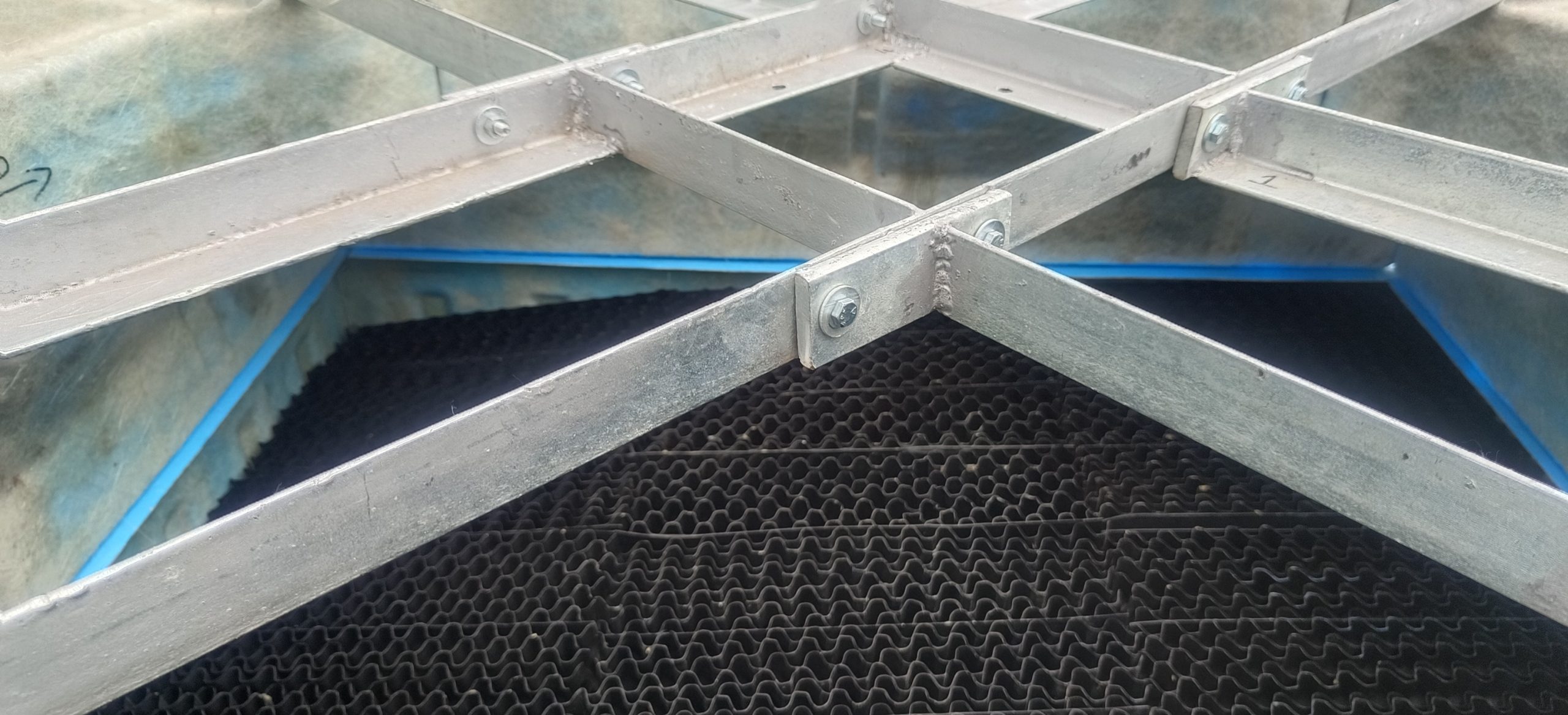
Induced Draft, Single-Flow, Cross Flow Cooling Tower
Core Definition
An Induced Draft, Single-Flow, Cross Flow Cooling Tower is a mechanical cooling tower where:
- Induced Draft: A fan at the top pulls air upwards through the tower.
- Single-Flow: Air enters from one side only of the tower.
- Cross Flow: The flow of air is horizontal and the flow of water is vertical downward, crossing each other at 90° angles.
How It Works (Step-by-Step)
- Water Distribution: Hot water from the process is pumped to an open gravity distribution basin at the top of the tower.
- Water Flow: Water flows vertically downward by gravity from the basin through orifices (no nozzles required). It then falls through the fill/packing.
- Air Flow: Ambient air is pulled horizontally through inlet louvers on one side of the tower by the induced draft fan at the top.
- Heat & Mass Transfer: In the fill section, the horizontal air stream comes into direct contact with the falling water film, facilitating evaporative cooling.
- Exit: Cooled water collects in the cold water basin below. The warm, moist air is exhausted vertically out the top by the fan.
Key Components & Their Role in Cross Flow Design
- Open Gravity Distribution Basin: A key differentiator. A hot water basin at the top with precisely sized holes, allowing water to be distributed by gravity without pressure nozzles. Made of FRP or coated steel.
- Inlet Louvers (Single Side): Located on one side only to direct air and prevent water splash-out.
- Fill/Packing: Typically splash-type fill (bars, grids) or film fill. The vertical fill stacks are arranged so water breaks into droplets/film as air passes horizontally through it.
- Induced Draft Fan: Single axial fan mounted on top of the plenum chamber.
- Drift Eliminators: Located above the fill and below the fan, they remove entrained water droplets from the exhaust air.
- Cold Water Basin: Collects cooled water at the bottom.
Advantages (Why Choose This Design?)
- Low Pumping Head Required: Gravity-fed water distribution operates at very low pressure (typically 1-2 psi), reducing pump energy costs.
- Easy Maintenance of Distribution System: The open basin is easily accessible for inspection and cleaning of debris/scale from orifices.
- Handles Dirty Water Better: Larger orifices and splash fill are less prone to clogging from suspended solids compared to pressurized nozzle systems.
- Good Accessibility: The single-flow design leaves one side completely open for access to fill and basin during maintenance.
- Simplicity & Reliability: Simple distribution system with fewer small components (nozzles) to fail.