

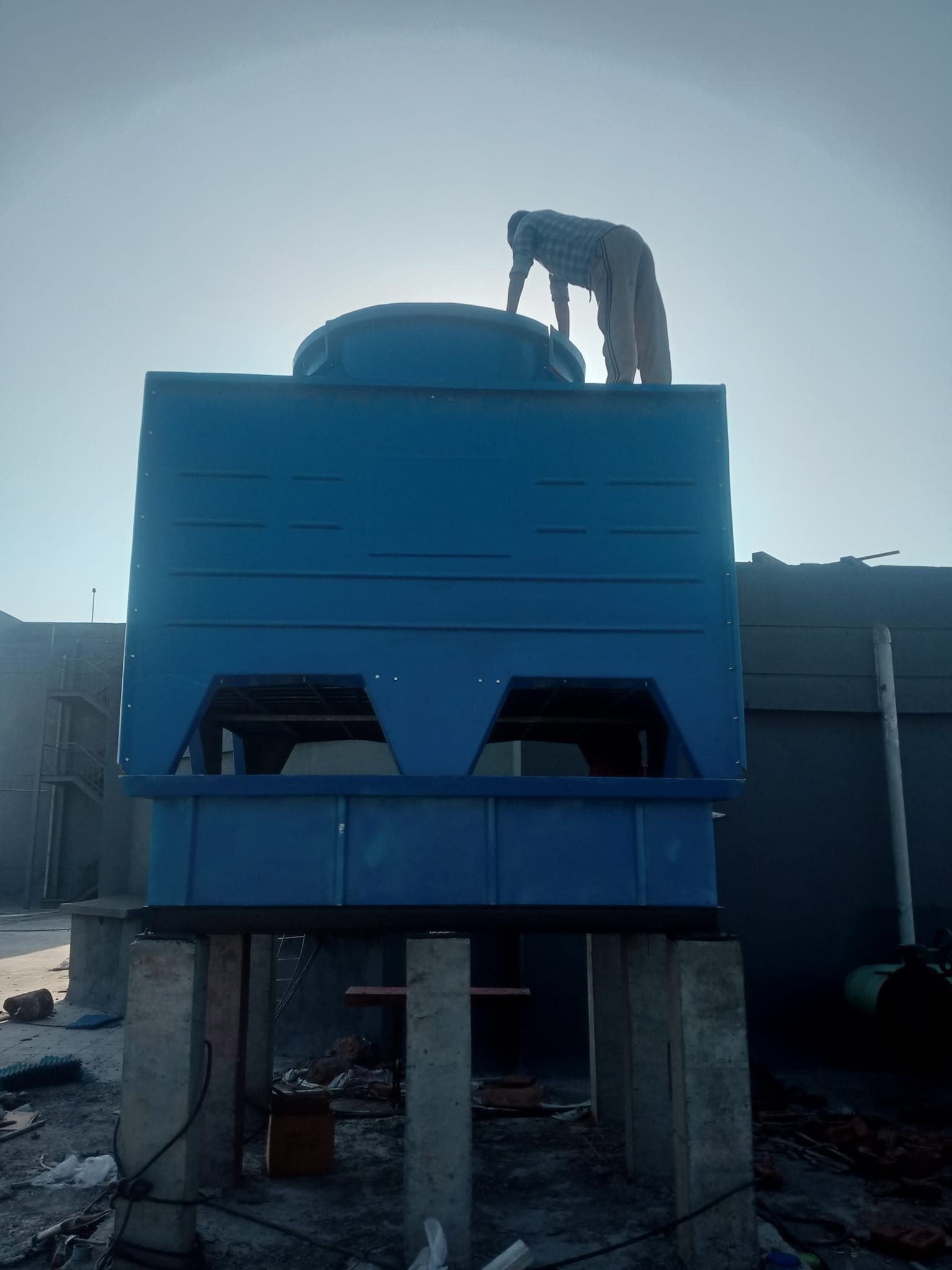
Square / Rectangular Shape FRP Cooling Tower
Definition
A Square or Rectangular FRP Cooling Tower is a modular or factory-assembled mechanical draft cooling tower with a box-like geometry, constructed primarily from Fiber Reinforced Plastic (FRP) panels, basins, and structural components. It is the most common and versatile design for industrial and large commercial applications.
Design & Configuration
- Shape & Structure:
- Casing: Made of flat or corrugated FRP panels bolted or bonded to a steel or FRP frame. The shape is inherently strong and easy to modularize.
- Modularity: Can be constructed as a single cell or multiple cells combined in parallel to increase capacity (e.g., 2-cell, 4-cell, 8-cell towers).
- Airflow Types:
- Counter flow Design (Most Common): Fan(s) on top, air drawn vertically upward against falling water. Fill is directly below the fan.
- Cross Flow Design: Fan(s) on top, air drawn horizontally across the falling water. Features an open rain distribution basin and fill on the sides.
- Fan Arrangement:
- Centrifugal Fans: Used for higher static pressure situations, often in indoor installations with ductwork.
- Axial Fans: Most common for standard outdoor applications, mounted on top of the tower.
Key Features & Advantages
- High Modularity & Scalability: Capacity can be easily increased by adding identical cells side-by-side. Easy to ship and assemble on-site.
- Excellent Maintainability: Large, removable panels provide full access to fill, drift eliminators, and mechanical equipment for inspection and cleaning.
- Structural Rigidity: The box shape and potential for internal bracing allow for larger spans and capacities than typical cylindrical FRP towers.
- Efficient Use of Space: Rectangular footprint allows for efficient layout along building walls or in equipment yards.
- Flexible Configuration: Can be configured for different flow paths (Counter flow/Cross Flow), fan types, and motor locations (direct drive or belt drive).
- Cost-Effective for Large Capacities: Per-ton cost often decreases with larger multi-cell designs.
Typical Applications
- Heavy Industrial Processes: Refineries, chemical plants, steel mills, manufacturing facilities.
- Large HVAC Systems: District cooling plants, large campuses, hospitals, airports.
- Power Plants (Auxiliary Cooling): For smaller units or auxiliary systems within large plants.
- Any application requiring high cooling capacity, reliability, and easy maintenance.
Comparison: Square/Rectangular vs. Bottle-Shape FRP Towers
| Feature | Square/Rectangular FRP Tower | Bottle-Shape (Cylindrical) FRP Tower |
| Footprint | Rectangular, efficient for lining up | Circular, better for scattered placement |
| Modularity | Excellent (multi-cell) | Typically single unit |
| Maintenance Access | Excellent (large panels) | More restricted (manway access) |
| Capacity Range | Very wide (small to very large) | Small to Medium |
| Air/Water Mixing | Can be Cross Flow or Counter flow | Almost exclusively Counter flow |
| Wind Loading | Higher (flat surfaces) | Lower (aerodynamic shape) |
| Aesthetics | Industrial/utilitarian | Often considered more visually pleasing |
Components (Typical Rectangular Counter flow Design)
- FRP Casing & Louvers: Corrosion-resistant enclosure.
- Fan Deck & Fan Stack (FRP): Houses the axial fan and motor.
- Eliminators: FRP drift eliminators to conserve water.
- Spray System: PVC nozzles and distribution piping.
- Fill/Packing: PVC or PP film or splash fill, supported by FRP grids.
- Cold Water Basin: Often a monolithic FRP basin (key advantage – leak-proof and corrosion-resistant).
- Structural Frame: Typically galvanized steel or sometimes FRP.