

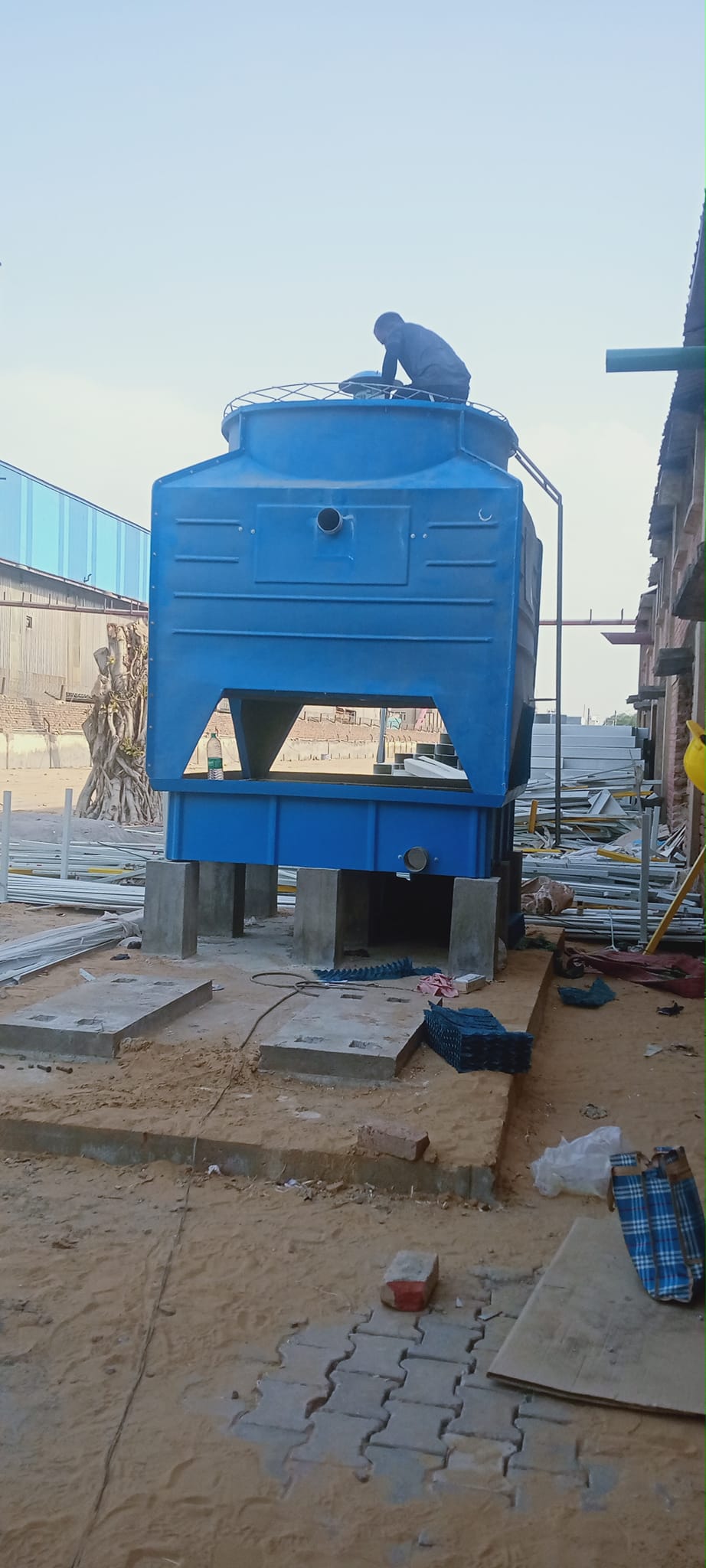
Bottle-Shaped Cooling Tower (Hyperbolic Natural Draft)
Definition & Visual Identity
A bottle-shaped cooling tower refers to the iconic, large hyperbolic natural draft cooling tower commonly seen at thermal power plants and large industrial facilities. Its shape resembles a giant bottle or hourglass.
Why the Hyperbolic Shape?
- Structural Strength:
- The hyperboloid geometry provides exceptional strength using minimal material (reinforced concrete).
- Efficiently handles wind loads and self-weight.
- Aerodynamic Efficiency:
- Naturally creates a strong, steady updraft due to the chimney effect.
- Warm, moist air rises, pulling in cooler air at the base without mechanical fans.
How It Works (Natural Draft Principle)
- Hot Water Inlet: Warm water from the plant condenser is sprayed at the top inside the tower.
- Fill/Packing: Water trickles down over a fill medium, increasing surface area for air contact.
- Air Flow: Cool, dense air enters through the tower’s wide base.
- Evaporative Cooling: A small portion of water evaporates, removing heat and cooling the remaining water.
- Chimney Effect: Warm, humid air rises naturally due to lower density and exits through the narrow top, creating a continuous draft.
- Cold Water Collection: Cooled water collects in the basin for recirculation.
Key Components
- Hyperbolic Shell: Reinforced concrete structure.
- Sprinkler/Nozzle System: Top distribution.
- Fill Material: Splash-type or film-type fills.
- Cold Water Basin: Large concrete basin at bottom.
- Drift Eliminators: Near the top to limit water loss.
- Inlet Louvers: Around the base to control air entry.
Advantages
- Zero fan power required → very low operating cost.
- High reliability (few moving parts, less maintenance).
- Suitable for very large heat loads (up to 500+ MW per tower).
- Long lifespan (40+ years).
- Quiet operation (no large fans).
Applications
- Large thermal/nuclear power plants.
- Major refineries & petrochemical complexes.
- Where electricity cost for fans is prohibitive and space/water permit.
Distinctive Features
- Visible plume (water vapor) exiting the top in cool/humid weather.
- Often painted with high-visibility stripes for aviation safety.
- Can be built as dry, wet, or hybrid systems for water conservation.
Environmental Note
- Water consumption is high (evaporative loss).
- Plume visibility and potential icing near tower in winter.
- Sometimes mistaken for “smoke” (but it’s just water vapor).