

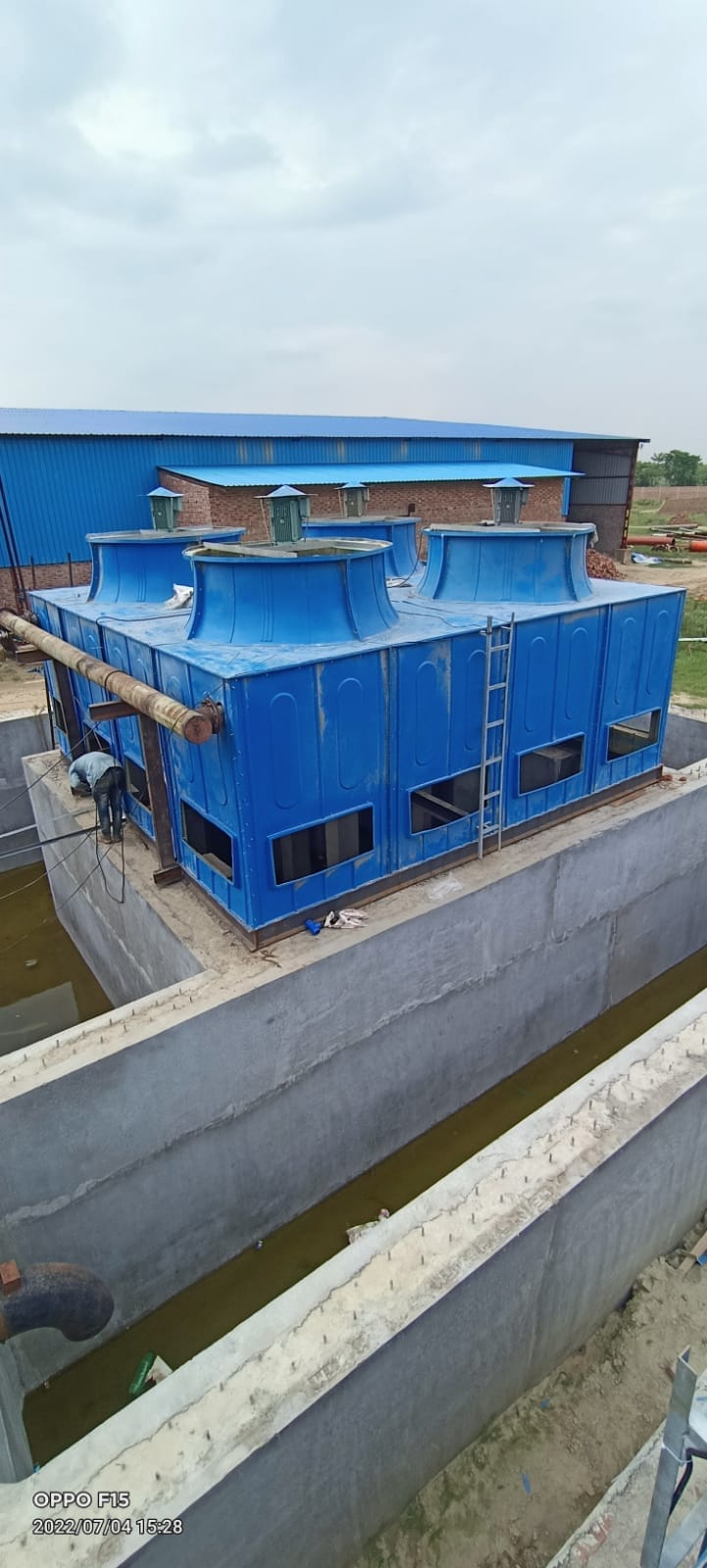
Cooling Tower Fills/Packing: The Heart of Heat Transfer
Cooling tower fills (also called packing or wetdeck) are the core heat exchange medium inside a cooling tower. They create an extensive surface area for air and water to interact, maximizing evaporation and cooling efficiency.
Primary Function
To increase contact surface area and contact time between hot water and air, thereby promoting:
- Evaporative cooling (latent heat transfer)
- Sensible heat transfer (convection)
- Effective distribution of water
Types of Cooling Tower Fills
1. Splash Fill
- How it works: Breaks falling water into small droplets through a series of splash bars or grids.
- Design: Multiple layers of horizontal bars, staggered to intercept and redistribute water droplets.
- Materials: Traditionally wood, now mostly PVC or polypropylene.
- Pros:
- Resistant to fouling (good for dirty water)
- Handles high suspended solids
- Low pressure drop
- Cons:
- Less efficient than film fill (larger droplets = less surface area)
- Larger tower size required for same duty
- Best for: Water with high suspended solids, high silt loads, or where biological growth is a problem.
2. Film Fill
- How it works: Spreads water into thin films over closely spaced parallel sheets.
- Design: Corrugated or textured PVC sheets placed vertically or at angles.
- Materials: Primarily PVC, CPVC for higher temperatures.
- Pros:
- Highest thermal efficiency (thin films = maximum surface area)
- Compact design (smaller tower footprint)
- Excellent water distribution
- Cons:
- Prone to fouling and clogging
- Higher pressure drop
- More sensitive to water quality
- Best for: Clean water applications, where space is limited, maximum efficiency needed.
3. Hybrid/Mixed Fill
- Combines film fill in upper sections (for efficiency) with splash fill in lower sections (for fouling resistance).
- Benefits: Good balance between efficiency and fouling resistance.
Key Design Characteristics
Fill Pattern Configuration
- Vertical Flow: Sheets arranged vertically (common in counter flow towers)
- Cross flow: Diagonal or horizontal arrangement (common in cross flow towers)
Flute/Corrugation Design
- 60° flutes: Standard angle, good balance
- 45° flutes: Lower pressure drop
- Herringbone pattern: Enhanced water distribution
- Textured surfaces: Create turbulence, improve heat transfer
Critical Performance Parameters
| Parameter | Importance | Typical Values |
| Surface Area Density | More area = better heat transfer | 100-250 m²/m³ |
| Void Fraction | Space for airflow | 85-98% |
| Pressure Drop | Affects fan power | 0.1-0.5 in. H₂O/ft |
| Thermal Performance (KaV/L) | Heat transfer coefficient |
| Water Loading | Flow per unit area |