

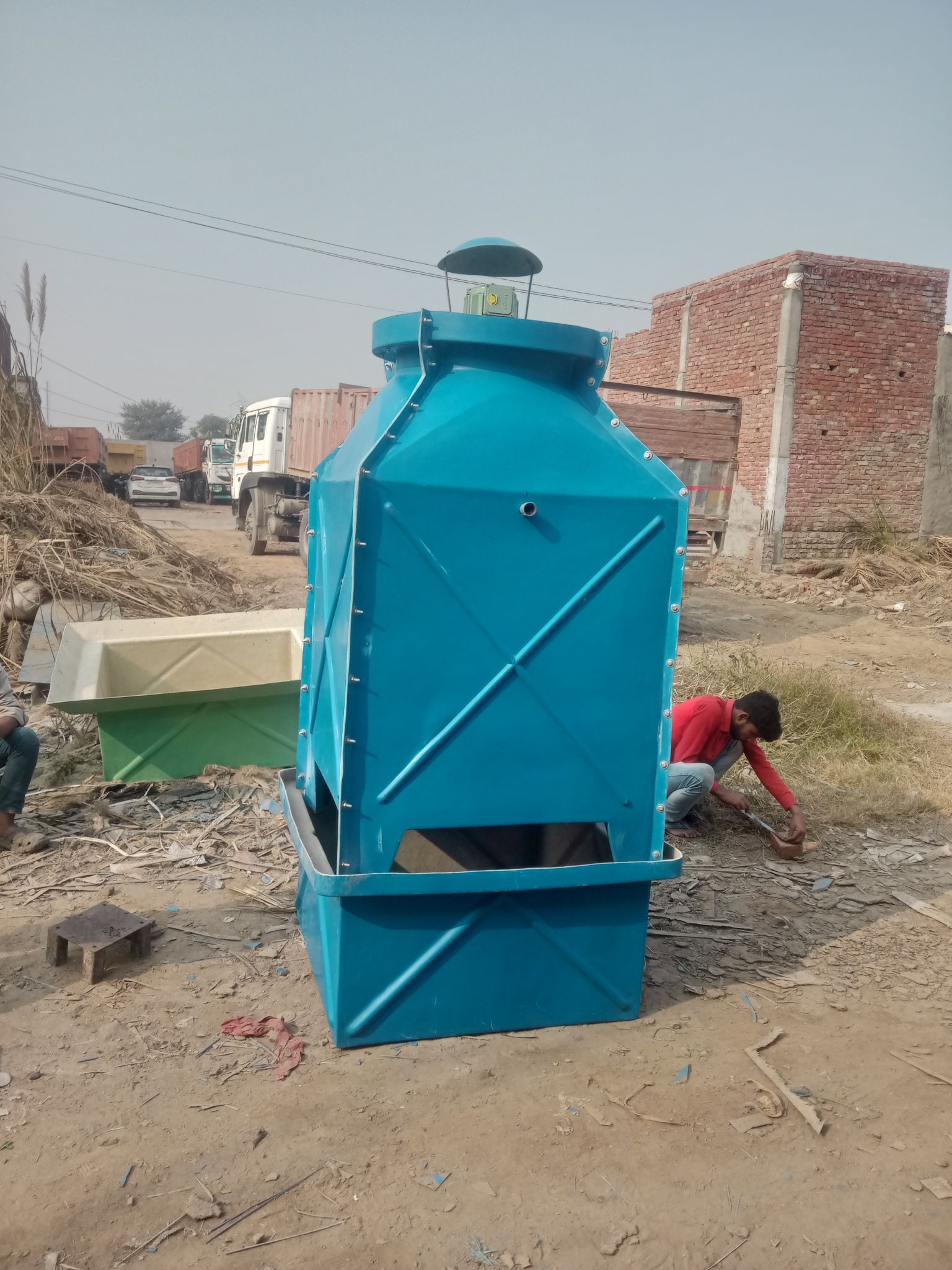
How Forced Draft & Induced Draft Cooling Towers Work
These are the two main mechanical draft cooling tower designs, differentiated by fan placement and airflow direction. Both use fans to overcome air resistance but have distinct operational characteristics
Forced Draft Cooling Towers
Working Principle
- Fan Location: At the BASE or AIR INLET SIDE of the tower.
- Airflow: Fan PUSHES air into the tower.
- Pressure: Creates positive pressure inside the tower below the fan.
Step-by-Step Operation
- Air Entry: Ambient air is forced into the tower by a centrifugal or axial fan located at the bottom/side.
- Air-Water Contact: Air moves upward through the fill, contacting the falling hot water.
- Heat Exchange: Evaporative cooling occurs as air absorbs heat and moisture.
- Air Exit: Warm, moist air exits through the top opening (no fan resistance at exit).
- Water Flow: Hot water is distributed at the top, falls through fill, collects at bottom basin.
Induced Draft Cooling Towers
- Fan Location: At the TOP (discharge) of the tower.
- Airflow: Fan PULLS air through the tower.
- Pressure: Creates negative pressure (suction) inside the tower.
Step-by-Step Operation
- Air Entry: Air enters naturally through side louvers due to suction created by top fan.
- Air-Water Contact: Air moves horizontally (Cross Flow) or upward (Counter Flow ) through fill.
- Heat Exchange: Evaporative cooling occurs.
- Air Exit: Fan at top actively pulls air through fill and discharges it vertically.
- Water Flow: Similar to forced draft but with different air patterns.