

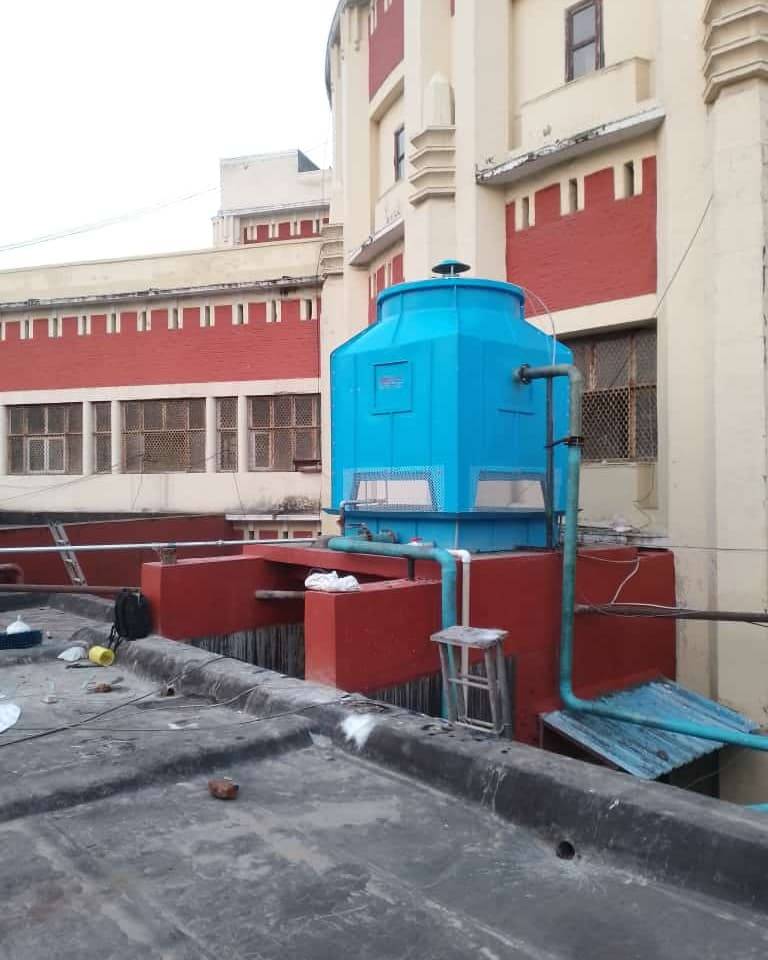
A Cross flow Cooling Tower is a type of mechanical draft, wet cooling tower where the flow of air is horizontal (side to side), perpendicular to the vertical fall of the water. This creates a distinct “cross” pattern of air and water flows.
Step-by-Step Working Principle
1. Hot Water Inlet & Distribution
- Hot water from the industrial process or chiller condenser (typically 35–45°C / 95–113°F) is pumped to the hot water distribution basin located at the top of the tower, above the fill material.
- Distribution is by gravity: The basins have metering orifices (nozzles or holes) along their bottom. Water flows out by gravity, requiring very low pressure (only enough to lift it to the basin).
2. Water Falls Through Fill Media
- Water falls vertically downward from the distribution basins in the form of sheets or droplets.
- It passes through fill material (also called “packing”), which is arranged in vertical sheets or grids. The fill’s purpose is to:
- Increase surface area for air-water contact.
- Slow the fall of water to increase contact time.
- Break water into thin films or droplets.
3. Airflow (Horizontal)
- Air is drawn horizontally across the falling water by one or more fans located at the top of the tower (induced draft) or at the side (forced draft).
- Induced draft is most common: fans at the top pull air horizontally through the fill from the open sides (louvers) of the tower.
- Key Feature: Air moves perpendicular (90°) to the direction of the falling water → hence “Cross flow.”
4. Heat & Mass Transfer
- As air moves horizontally through the wet fill, it comes into direct contact with the falling hot water.
- Evaporative Cooling Occurs:
- A small portion of the water (1–2%) evaporates, absorbing latent heat from the remaining water.
- This cools the bulk of the water.
- Sensible heat transfer also occurs as air heats up.
5. Cooled Water Collection
- The cooled water collects in the cold-water basin at the bottom of the tower.
- It is then pumped back to the process or chiller to absorb heat again, completing the loop.
6. Air & Moisture Exhaust
- The warm, moist air is pulled upward by the fan and discharged vertically into the atmosphere.
- Drift eliminators (zig-zag blades) are installed above the fill to capture entrained water droplets and minimize water loss.