

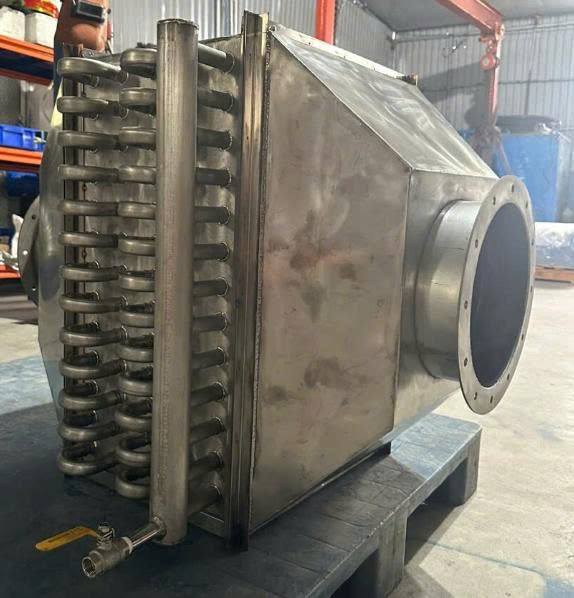
An extruded fin tube, also known as a bimetal tube, is manufactured by physically forming the fins from a secondary metal sleeve (usually aluminum) onto a base tube (usually carbon or stainless steel). The fins and the base tube become a single, integral unit with an excellent metallurgical bond.
The Manufacturing Process: How It’s Made
The process is key to understanding its advantages:
- Base Tube Preparation: A base tube (the “core” tube) is selected based on the internal fluid’s pressure and corrosion requirements (e.g., carbon steel, stainless steel).
- Aluminum Sleeve: A sleeve of aluminum is fitted snugly over the base tube.
- Extrusion: The assembly is pushed at high pressure through a series of staggered discs or dies. These discs contain holes slightly larger than the base tube’s outer diameter.
- Fin Formation: As the assembly is forced through these dies, the aluminum sleeve is squeezed. With nowhere else to go, the aluminum is cold-extruded radially outward, forming the fins.
- Bonding: Simultaneously, the aluminum is forced inward at a microscopic level, filling the surface imperfections of the base tube. This creates a massive mechanical, interference-fit bond known as a metallurgical bond. The aluminum is effectively “pressure-welded” to the steel core.
Key Advantages of Extruded Fin Tubes
This unique manufacturing process gives extruded fin tubes several distinct benefits:
- Superior Bond Strength and Durability:
- The bond is extremely robust and resistant to thermal cycling. As the tube heats up and cools down, the aluminum and steel expand at different rates. The extruded bond can handle this stress without loosening, unlike mechanically wrapped fins which can relax over time.
- Highly resistant to fin vibration, which is common in air-handling equipment.
- Excellent Heat Transfer Efficiency:
- The metallurgical bond has minimal contact resistance. There are no air gaps or poor contact points between the fin and the tube, which can act as insulation in other types. Heat flows very efficiently from the core tube directly into the fin.
- Robust Fins:
- The extruded fins are solid and durable, making them much more resistant to physical damage during handling, cleaning, or operation than thin, wrapped aluminum fins.
- Excellent Corrosion Protection for the Base Tube:
- The aluminum sleeve completely seals the carbon steel tube from the outside environment. This provides a built-in, durable corrosion barrier, which is a significant advantage over bare carbon steel tubes.
- Good Flexibility:
- While the fin material is almost always aluminum, the core tube can be made from a wide variety of materials (CS, SS, copper, brass) to handle different internal fluids and pressures.
| Feature | Extruded Fin | L-Finned (Wrapped) | Welded Fin |
| Bond Type | Metallurgical Interference Fit | Mechanical | Metallurgical (Weld) |
| Fin Material | Almost always Aluminum | Typically Aluminum | Steel, Stainless Steel, etc. |
| Thermal Cyclability | Excellent | Fair to Poor | Excellent |
| Max Temp | ~280°C (535°F) | ~180°C (350°F) | >800°C (1470°F) |
| Corrosion Protection | Excellent (for base tube) | Good | Good |
| Relative Cost | Medium | Lowest | Highest |