

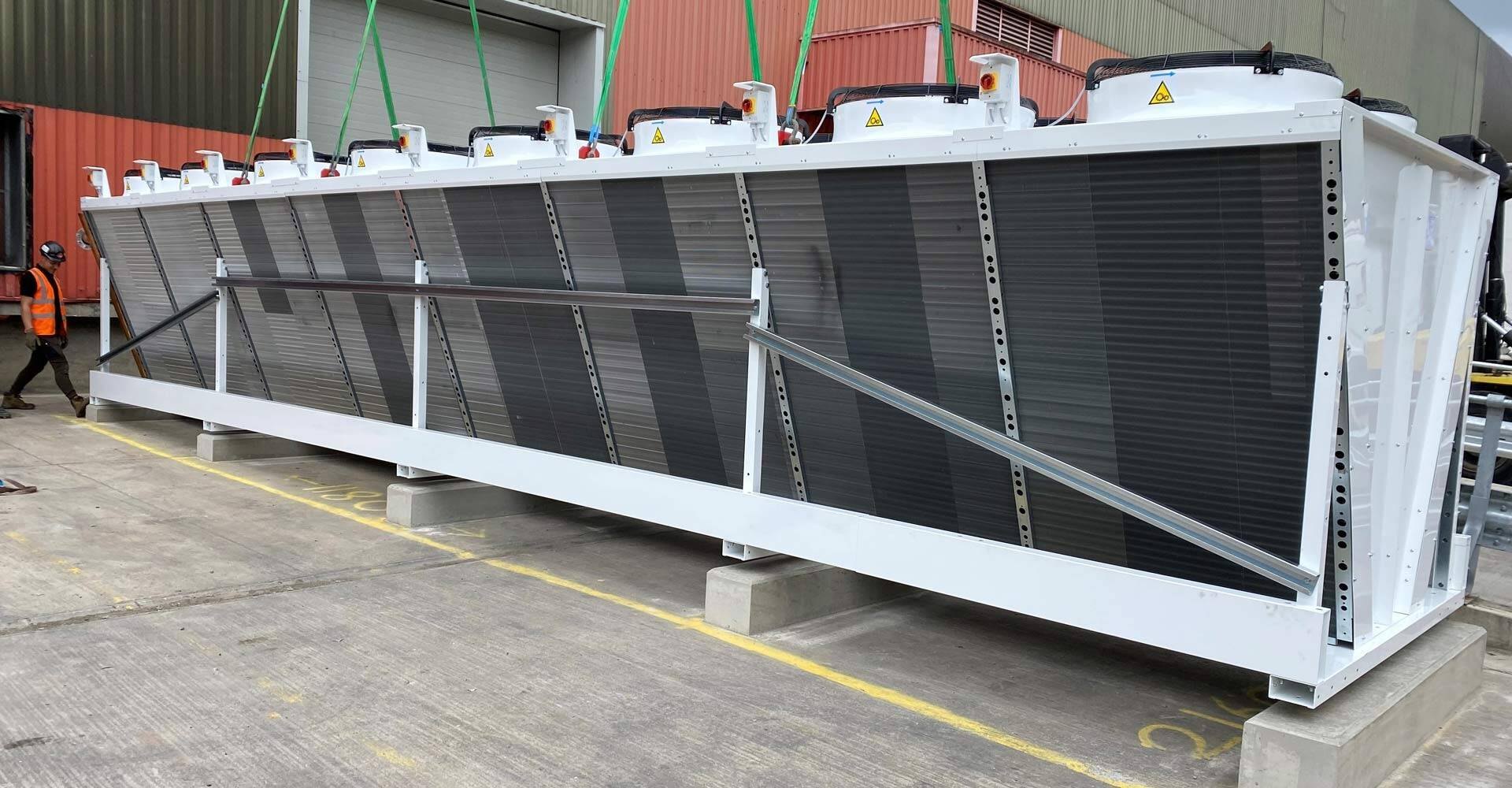
Cellulose Pad vs. Misting Nozzles in Dry cooling Tower
The choice between Cellulose Pads and Misting Nozzles fundamentally comes down to a trade-off between efficiency/maintenance and cost/footprint.
Both systems serve the same primary purpose: to pre-cool the air entering a dry cooler by evaporating water, thereby boosting performance on hot days. However, they achieve this in very different ways.
Here is a detailed comparison:
Head-to-Head Comparison
| Feature | Cellulose Pads | Misting Nozzles (High-Pressure) |
| Principle & Efficiency | Highly Efficient Evaporative Cooling. Air is forced through a saturated, porous medium. Achieves near-perfect evaporation, cooling air close to the wet-bulb temperature. | Flash Evaporation. Water is atomized into billions of tiny droplets that flash-evaporate in the air. Efficiency depends on droplet size and air conditions; can be less complete. |
| Water Drift & Carryover | Very Low. The pad acts as a giant filter and eliminator. Liquid water is contained within the pad structure, minimizing carryover to the coil. | Potentially High. If droplets are too large or airflow is wrong, un-evaporated water can be carried onto the coil, leading to scaling and fouling. |
| Impact on Main Coil | Protective. The pad filters dust and particulates from the air, keeping the main heat exchanger cleaner. Pre-cooled, humidified air is dry to the touch. | Risky. Mineral deposits from unevaporated water can clog fins and coat the coil, acting as an insulator and reducing heat transfer efficiency over time. |
| Water Quality Sensitivity | Moderate. Suspended solids can clog the pad, but they are less sensitive to dissolved minerals since the water is contained in the recirculating system. | Very High. Dissolved minerals (hardness) in the water will directly precipitate onto the coil and nozzles. Requires very soft or demineralized water. |
| Maintenance | Predictable, Periodic. Pads have a finite lifespan (typically 3-8 years) and need replacement. The system requires a water treatment program to control algae and scale in the sump. | Frequent & Intensive. Nozzles are prone to clogging and require regular inspection and cleaning. The high-pressure pump and filters also need maintenance. |
| Energy Consumption | Lower. Uses a low-power recirculation pump. The primary energy user remains the fans. | Higher. Requires a powerful, high-pressure pump (1000+ psi) to atomize the water, adding significant energy load. |
| Footprint & Space | Larger. Requires the physical footprint for the pad assemblies on the air intake sides of the cooler. | Very Compact. Nozzles and piping take up minimal space, making them ideal for retrofits on existing dry coolers. |
| Initial Cost | Higher. Cost of the pad assemblies, support structure, and larger water basin. | Lower. Generally cheaper to install, especially as a retrofit. |
| Freeze Protection | More Complex. The entire pad and water distribution system can freeze and be damaged in winter, requiring drain-down or heating systems. | Simpler. Systems can be designed to fully drain, reducing freeze risk. |