

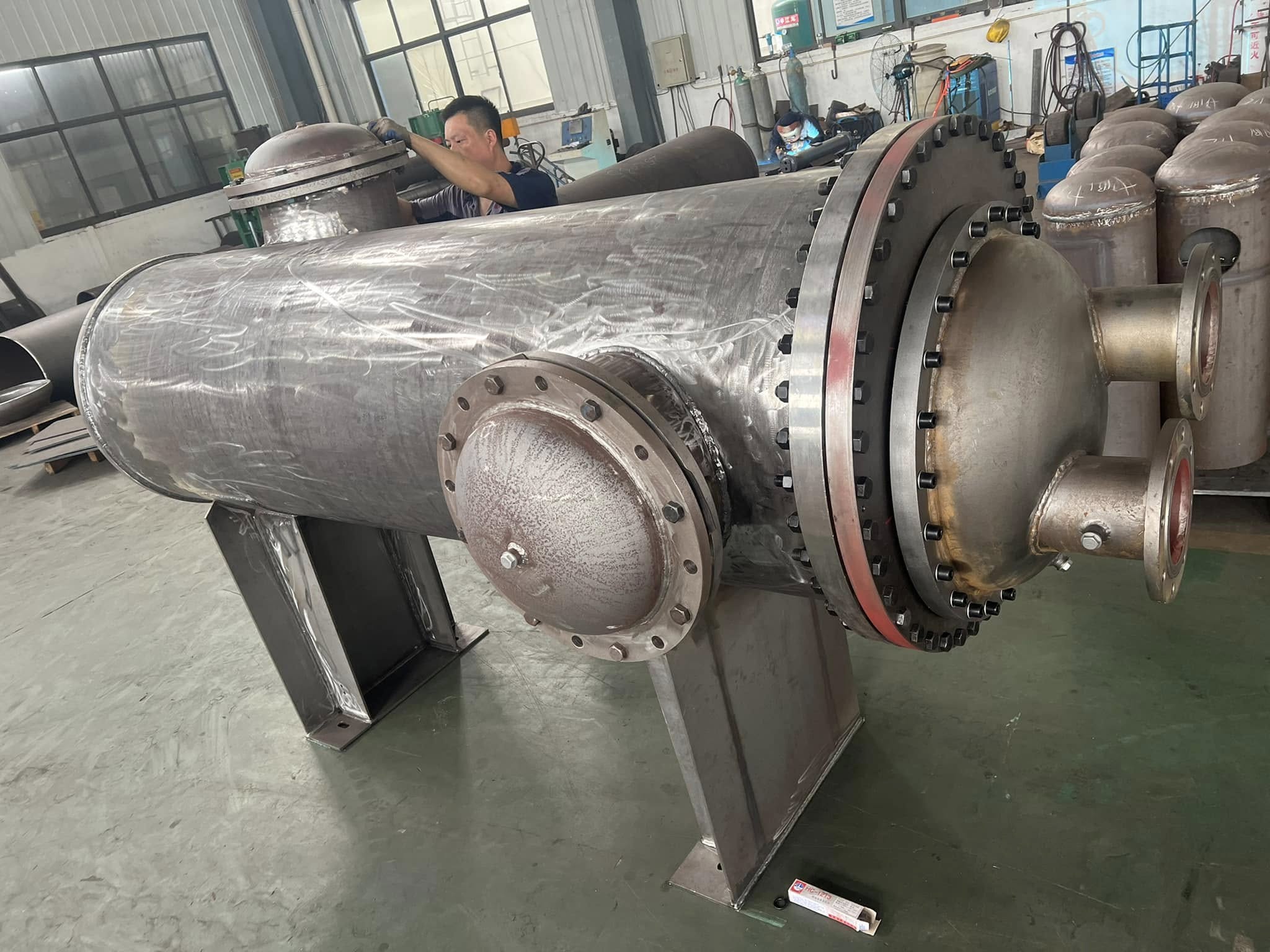
se of Shell and Tube Heat Exchanger in HVAC & Refrigeration System
- Chillers & heat pumps.
- District heating/cooling systems.
Titanium (For Highly Corrosive Media)
- Grade 2 or Grade 7 (Pd-alloyed for HCl resistance)
- Excellent for saltwater, acidic fruit juices (citric acid), vinegar.
- Used in seafood processing, pickling plants.
C. Copper Alloys (Limited Use – Mostly Historical)
- Cupronickel (90/10 or 70/30 Cu-Ni)
- Good for pasteurizers, brewing.
- Disadvantage: Not ideal for acidic foods (can leach ions).
D. Nickel Alloys (Special Cases)
- Hastelloy C-276 / Inconel 625
- Used for extremely corrosive foods (e.g., high-acid juices, sulphite solutions).
2. Shell Material
- SS 304 or SS 316 (same as tubes for consistency).
- Carbon Steel with Stainless Steel Cladding (for cost savings in large exchangers).
3. Gaskets & Seals
- FDA-Approved EPDM (Ethylene Propylene Diene Monomer) – For hot water/steam.
- PTFE (Teflon) – Chemical resistance, used with aggressive CIP cleaners.
- Silicone – High-temperature flexibility.
4. Surface Finish Requirements
- Ra (Roughness Average) ≤ 0.8 µm (smooth finish for cleanability).
- Electropolishing (for ultra-hygienic applications like baby food, dairy).
5. Design Considerations for Food Industry
Sanitary Design:
- No dead zones (fully drainable).
- Easy disassembly for cleaning (removable tube bundles).
CIP (Clean-in-Place) Compatibility:
Must withstand caustic (NaOH), acidic (HNO₃), and sanitizing (peracetic acid) solutions.