

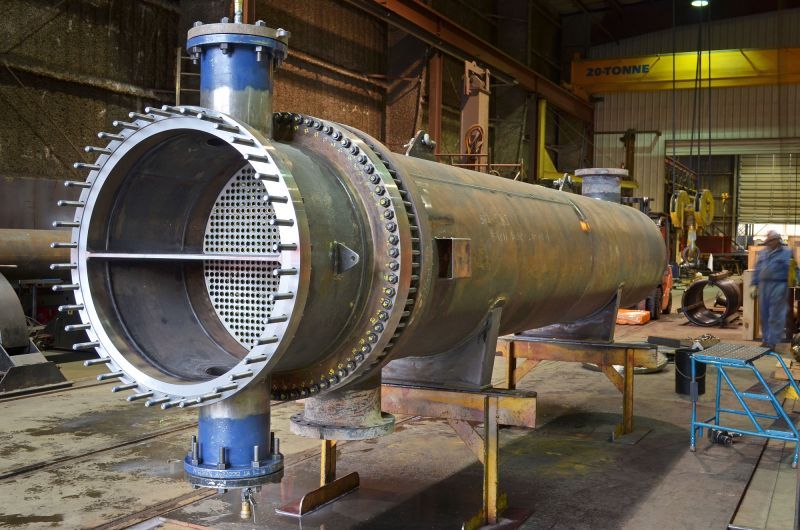
hell and Tube Heat Exchanger vs. Plate Heat Exchanger: Key Differences
Choosing between a shell and tube (STHE) and a plate heat exchanger (PHE) depends on application requirements, operating conditions, and cost. Below is a detailed comparison:
1. Design & Construction
| Feature | Shell and Tube (STHE) | Plate Heat Exchanger (PHE) |
| Structure | Cylindrical shell with tubes | Stacked corrugated plates with gaskets/welds |
| Surface Area | Lower compactness (larger footprint) | High compactness (more surface area in small space) |
| Materials | Metals (CS, SS, Ti, Cu-Ni) | SS 316, titanium, graphite, polymer-coated |
| Maintenance | Removable bundle (some designs) | Easy to clean (gasketed), but welded types are harder |
STHE: Better for high-pressure/temperature applications.
PHE: More compact & efficient for low-viscosity fluids.
2. Performance Comparison
| Parameter | Shell and Tube | Plate Heat Exchanger |
| Heat Transfer Efficiency | Moderate (lower turbulence) | High (turbulent flow between plates) |
| Approach Temperature | ~5–10°C | ~1–2°C (better for close temp. approaches) |
| Fouling Resistance | Handles fouling better (larger passages) | Prone to clogging (narrow gaps) |
| Pressure Drop | Lower (straight tubes) | Higher (tortuous flow path) |
| Max Pressure | Up to 3000 psi (ASME Div 1/2) | ~300 psi (gasketed), ~600 psi (welded) |
| Max Temperature | 600°C+ (special designs) | ~200°C (gasketed), ~400°C (welded) |
STHE: Best for high-pressure/temperature, fouling fluids.
PHE: Best for high efficiency, low-fouling applications.
3. Applications
| Industry | Shell and Tube | Plate Heat Exchanger |
| Oil & Gas | Refineries, high-P steam | Limited (low-P applications) |
| Power Plants | Condensers, boilers | Lubrication oil cooling |
| Chemical | Corrosive/high-T processes | Low-P chemical mixing |
| Food & Beverage | Pasteurization (SS 316L) | Preferred (easy CIP cleaning) |
| HVAC | Chillers, district heating | Common (compact, efficient) |
STHE: Heavy-duty industrial uses (refineries, power plants).
PHE: Food, HVAC, and low-fouling processes.4. Cost Comparison
| Factor | Shell and Tube | Plate Heat Exchanger |
| Initial Cost | Higher (large size, more material) | Lower (compact, less material) |
| Maintenance Cost | Higher (if fixed tube sheet) | Lower (gasketed types easy to clean) |
| Lifespan | 20–30+ years | 10–15 years (gaskets degrade) |
Trade-off:
- STHE: Higher upfront cost but longer lifespan in harsh conditions.
- PHE: Cheaper initially but may need frequent gasket replacements.
5. Pros & Cons Summary
Shell and Tube Advantages
Handles high pressure & temperature.
Better for fouling & viscous fluids.
Longer lifespan in harsh environments.
Shell and Tube Disadvantages
Bulky & heavy (large footprint).
Lower efficiency than PHE for low-viscosity fluids.
Harder to clean (fixed tube sheet designs).
Plate Heat Exchanger Advantages
Compact & lightweight (saves space).
Higher thermal efficiency (close temp. approach).
Easy to clean & expand (add plates for more capacity).
Plate Heat Exchanger Disadvantages
Not for high-P/high-T (gaskets fail).
Clogs easily with particulates.
Gasket degradation (requires periodic replacement).
6. Which One to Choose?
Choose Shell and Tube If:
- High pressure (>300 psi) or temperature (>200°C).
- Fouling/viscous fluids (crude oil, slurry).
Long-term durability is critical.
Choose Plate Heat Exchanger If:
- Space is limited (HVAC, food plants).
- High efficiency needed (close ΔT).
- Fluids are clean & non-fouling (water, solvents).
Final Comparison Table
| Aspect | Winner |
| High Pressure/Temperature | Shell and Tube |
| Compactness & Efficiency | Plate Heat Exchanger |
| Fouling Resistance | Shell and Tube |
| Maintenance Ease | Plate (gasketed) |
| Cost-Effectiveness | Plate (for small scale) |
- STHE = Heavy-duty, high-P/T, long lifespan.
PHE = Compact, efficient, easy maintenance (for clean fluids).