

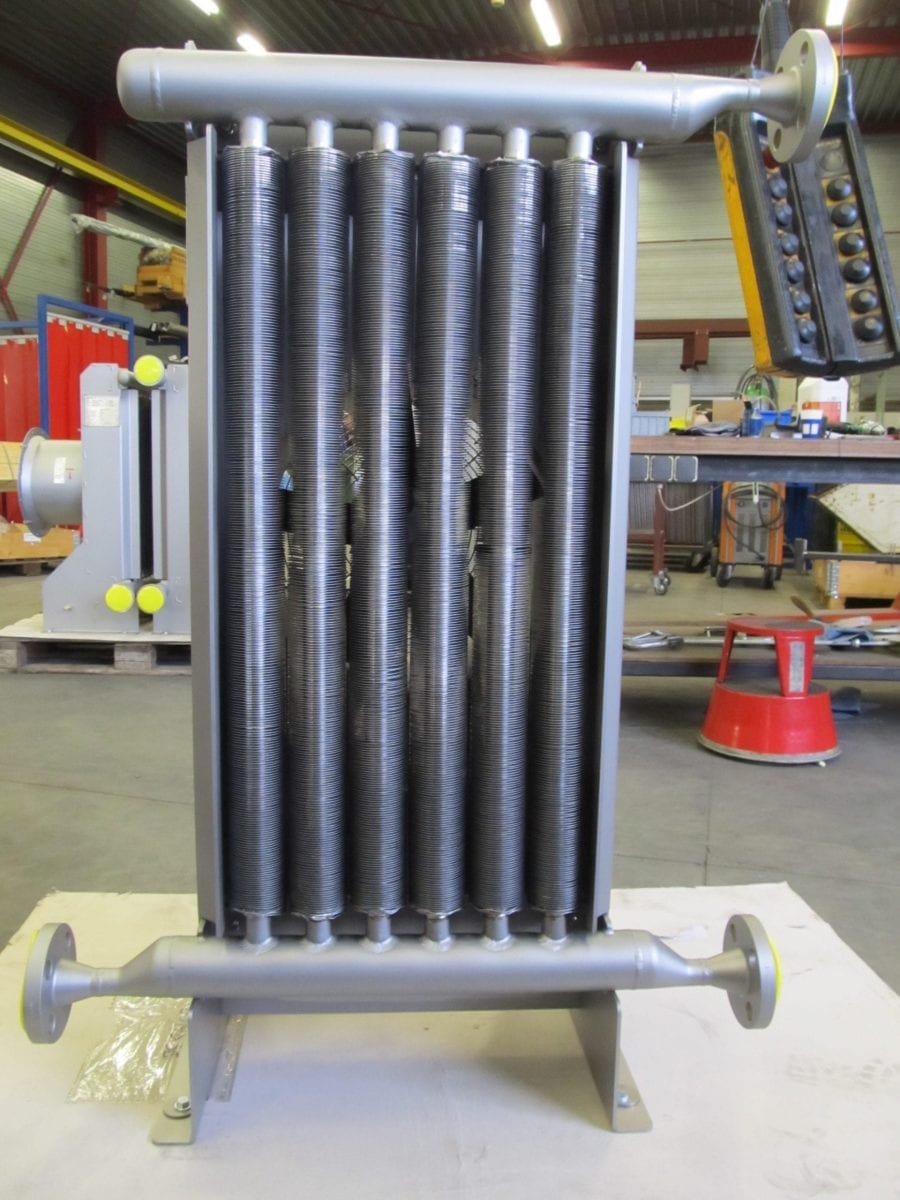
ir-cooled steam condensers (ACSCs) are specialized heat exchangers that convert exhaust steam from turbines back into water using ambient air cooling instead of water-cooled systems. They’re increasingly important in power generation and industrial processes where water conservation is critical.
1. Working Principle
- Steam Condensation: Low-pressure exhaust steam from turbines flows through finned tubes
- Air Cooling: Large fans force/pull ambient air across tube bundles
- Condensate Collection: Condensed water returns to the feedwater system
- Non-condensable Gas Removal: Vacuum system maintains proper pressure
2. Key Components
| Component | Function |
| Tube Bundles | Finned tubes for steam condensation |
| Axial Fans | Provide cooling airflow (forced/induced draft) |
| Steam Ducting | Distributes steam from turbine exhaust |
| Condensate Tank | Collects condensed water |
| Vacuum System | Maintains sub-atmospheric pressure |
| Air Removal System | Extracts non-condensable gases |
3. System Configurations
A. Direct Dry Cooling (ACC)
- Steam condenses directly in air-cooled tubes
- Used in most modern power plants
- No water consumption
B. Indirect Dry Cooling (Heller System)
- Steam condenses in surface condenser
- Cooling water loop rejects heat to air-cooled heat exchangers
- Lower efficiency but more stable operation
C. Hybrid Wet/Dry Systems
- Dry cooling with water spray augmentation during peak loads
- Balances water savings with performance
4. Advantages vs. Water-Cooled Condensers
Zero water consumption – Critical for arid regions
Lower environmental impact – No thermal pollution or water discharge
Reduced permitting – Avoids water rights issues
Flexible siting – Not limited to water sources
Lower maintenance – No biofouling or scaling
5. Challenges & Limitations
Higher capital cost – Larger footprint and more equipment
Lower efficiency – Performance varies with ambient temperature
Parasitic power loss – Fan power reduces net output
Cold weather issues – Potential freezing in winter
Air Cooled Heat Exchanger Noise concerns – Large fan arrays require mitigation
6. Design Considerations
- Climate analysis – Design for peak summer temperatures
- Tube layout – A-frame, horizontal, or vertical configurations
- Fan selection – Variable frequency drives for efficiency
- Freeze protection – Tube bundle heating systems
- Noise control – Low-noise fan designs and barriers
7. Applications
Power Generation
- Thermal power plants (coal, gas, biomass)
- Solar thermal power plants
- Geothermal plants
Industrial Processes
- Refineries
- Chemical plants
- District heating systems
8. Performance Optimization
- Variable speed fans – Adjust to load and ambient conditions
- Intelligent control systems – Optimize vacuum and fan operation
- Wind shields – Reduce performance degradation from crosswinds
- Advanced fin designs – Improve heat transfer efficiency
9. Maintenance Requirements
- Regular fin cleaning – Maintain airflow and heat transfer
- Fan maintenance – Bearing lubrication and alignment
- Leak detection – Steam and condensate systems
- Winterization – Freeze protection measures
Air-cooled steam condensers provide a water-smart solution for power plants and industrial facilities, particularly in water-scarce regions. While they involve higher initial costs and lower efficiency compared to water-cooled systems, their environmental benefits and operational advantages make them increasingly popular in sustainable energy systems.