

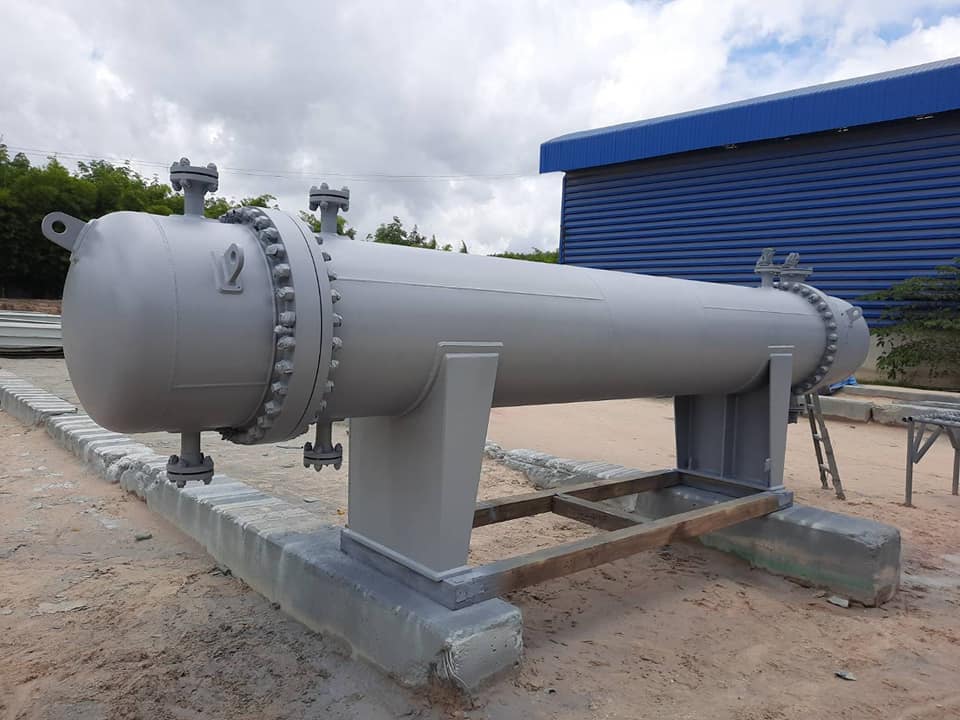
The Tubular Exchanger Manufacturers Association (TEMA) classifies shell and tube heat exchangers into three main designations based on service conditions, mechanical robustness, and industry requirements:
1. TEMA Class R – Refinery & Severe Service
Applications:
- Oil refineries, petrochemical plants, high-pressure/high-temperature (HPHT) services.
- Harsh environments (corrosive fluids, fouling, thermal cycling).
Key Features:
Heavy-duty construction (thicker shells, reinforced tube sheets).
Strict tolerances for leakage prevention.
Removable bundle designs (for easy cleaning/maintenance).
High-pressure ratings (ASME Div 1 or Div 2 compliance).
Common Configurations:
- AES (Front-end stationary head, single-pass shell, rear-end floating head).
- BEM (Bonnet-type front head, fixed tube sheet, single-pass shell).
2. TEMA Class C – Commercial & General Service
Applications:
- HVAC, power plants, food processing, light chemical industries.
- Moderate pressure/temperature, non-corrosive fluids.
Key Features:
Cost-effective (lighter construction than Class R).
Simpler fabrication (fewer stringent requirements).
Fixed or floating tube sheet designs.
Common Configurations:
- NEN (Channel-type front head, fixed tube sheet, single-pass shell).
- AEP (Front-end stationary head, single-pass shell, rear-end packed floating head).
3. TEMA Class B – Chemical Process Service
Applications:
- Chemical processing, pharmaceuticals, aggressive media (acids, solvents).
- High corrosion risk, frequent thermal cycling.
Key Features:
Balanced between Class R & C (better corrosion resistance than Class C).
More stringent than Class C but not as heavy as Class R.
Often uses exotic materials (titanium, Hastelloy, duplex SS).
Common Configurations:
- BKU (Bonnet-type front head, U-tube bundle, single-pass shell).
- AEW (Front-end stationary head, floating head with backing device).
Comparison Table: TEMA Classes R, C, and B
| Parameter | TEMA Class R | TEMA Class C | TEMA Class B |
| Service Conditions | Severe (HPHT, fouling) | Moderate (general-purpose) | Corrosive/cyclic |
| Construction Cost | Highest | Lowest | Medium |
| Maintenance | Removable bundles common | Fixed tube sheets common | Depends on design |
| Typical Industries | Oil & gas, refineries | HVAC, power plants | Chemical, pharma |
| Example Configs | AES, BEM | NEN, AEP | BKU, AEW |
TEMA Nomenclature Breakdown (Example: AES, BEM, NEN, etc.)
TEMA uses a 3-letter code to describe exchanger types:
- First Letter → Front Head Type
- A: Channel with removable cover (most common).
- B: Bonnet (integral cover, lower cost).
- N: Channel integral with tube sheet.
- Second Letter → Shell Type
- E: Single-pass shell.
- F: Two-pass shell.
- G: Split flow (for horizontal thermosiphon reboilers).
- Third Letter → Rear Head Type
- S: Floating head (removable bundle).
- T: Fixed tube sheet.
- U: U-tube design.
Example:
- AES = Removable front channel (A) + single-pass shell (E) + floating head (S).
- BEM = Bonnet front head (B) + single-pass shell (E) + fixed tube sheet (M).
When to Use Which TEMA Class?
- Class R → Refineries, high-pressure steam, fouling fluids.
- Class C → Low-cost HVAC, water cooling, non-corrosive duties.
Class B → Chemical plants, corrosive/thermal cycling services.